
Marion County Records Custodians
Three offices at 223 North Spalding Avenue in Lebanon hold most of the working parcel trail for Marion County. Suite numbers and duties differ. Bring the parcel and account numbers to the right counter, because the PVA supplies assessment identity, the clerk supplies recorded deed records, and the sheriff supplies tax collection status on the roll.
Marion County Clerk
223 N. Spalding Ave., Suite 102
Lebanon, KY 40033
270-692-2651
Marion County Sheriff
223 N. Spalding Ave., Suite 101
Lebanon, KY 40033
270-692-3051
Marion PVA Search Keys
Each qPublic mode solves a different property search problem. Address is the most direct start, while owner name can surface several parcels at once. Parcel ID works as the strongest cross-reference. Alternate ID recovers an account known from another record. Keep mailing and situs fields separate. The first is where notices go; the second locates the assessed parcel.
| Search mode | Best use | Key caution |
|---|---|---|
| Name | Find parcels tied to a person, trust, estate, or entity | Try exact name variants |
| Address | Locate a known site | Street names can change |
| Parcel ID | Cross-reference offices | Keep punctuation and zeros |
| Alternate ID | Use a known account key | Availability varies |
The public portal publishes no official refresh interval. A recent conveyance may show up first in the recorded deed, so check deed records before trusting the assessment card.
What Marion County Property Records Show
No single Marion County screen is a complete property record. The assessment card identifies the taxable parcel. The deed states what interest was conveyed, and a plat illustrates recorded geometry. The sheriff's account addresses one tax year. A court file may explain a dispute or judicial transfer. Keep the record type and its custodian beside every fact you gather.
| Record | Custodian | Best evidence |
|---|---|---|
| Assessment card | Marion PVA | Parcel identity, class, acreage, value fields |
| Deed or easement | County Clerk | Conveyed interest and legal description |
| Tax account | Sheriff | Year-specific collection status |
| Court filing | Circuit Clerk | Orders and property-related litigation |
Recorder Index Through 2026
The Marion recorded-document index offers grantor and grantee directions. It also covers first and last names, legal description, book and page, and a date range in MMDDYYYY format. Its inspected notice listed records through close of business on May 17, 2026. It warned that indexing might lag behind that date. Treat the notice as an operational update rather than a permanent cutoff. Grantor and grantee directions matter here. A deed search runs differently depending on which side of the transfer a name sits. The live index screen displays the search route itself, including the date-range fields.
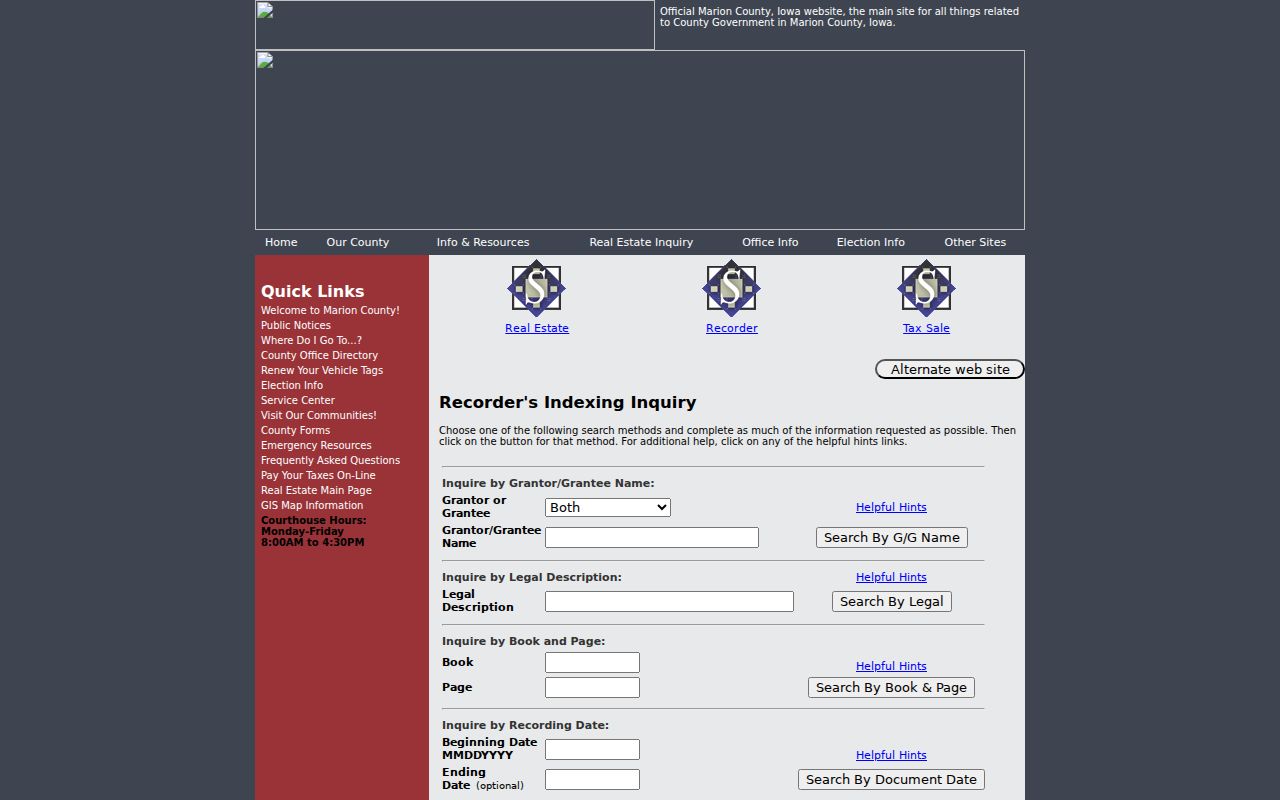
A missing recent result is not proof that no deed was recorded. Call the clerk before drawing any conclusion from the recorder index.
Historic Marion Land Records
Older Marion County property records follow a different path. The Kentucky Department for Libraries and Archives inventory lists deed microfilm from 1863 through 2010, tax assessment books spanning 1834 through 1875, wills from 1863 through 2010, and 1877 plats on microfiche. KDLA requests need useful locators and may take four to six weeks.
The 1863 courthouse disaster year deserves care. Do not assume every series was destroyed. Check the clerk's surviving books, KDLA film, old tax books, newspapers, and the names of adjoining owners. The Marion County Public Library Genealogy Room adds local newspapers, family files, microfilm, obituaries, Heritage Hub, and genealogy tools.
Marion Maps Need Deeds
The qPublic View Map route helps locate a parcel on a GIS map. It also shows roads and nearby outlines. Marion County offers no stable tool for buffer or select-adjacent work. A tax-map outline serves identification, not conveyance. For a larger print or data set, Kentucky DOR Mapping Services routes requests through the PVA. It also warns that its maps are not legal surveys.
- Parcel
- The PVA tax unit identified by its county key.
- Plat
- A recorded drawing that may show lots, blocks, easements, and parent tracts.
- Grantor
- The party conveying an interest.
- Grantee
- The party receiving it.
Marion Assessment Years
The official sample for parcel 064-005 shows how qPublic structures its fields. It separates a working year from certified years. It also breaks values into land, improvements, agricultural improvements, exemptions, net taxable value, and fair cash value. The sample proves the vocabulary rather than a current appraisal for every parcel.
Kentucky DOR requires a physical inspection of each parcel at least once every four years. New construction is added yearly. When a figure changes, compare year labels, property class, land and improvement portions, farm acres, and exemptions before guessing at a sale. The appraisal may simply have been rebalanced.
Open Records Beyond Portals
The Kentucky Open Records Act, KRS 61.870 through 61.884, frames the request process. The clerk accepts a precise written request by hand delivery, email, mail, or fax. The request must include requester and record details. Fees are required in advance, and the office answers within five business days. Ask whether the item can be inspected, copied, sent electronically, or certified.
This fallback matters when an online image is absent. Provide party names, an approximate date, record type, and parcel or legal-description terms. Include book and page if known. The clerk's open-records instructions give the current route.
Digitization Worth Rechecking
Three 2025 Kentucky Genealogical Society grants may add context for old Marion names and places. Marion County Public Library worked on rare Catholic Church records, the Marion County Historical Society on rare business and African-American Sunday School records, and Loretto Heritage Center on school ledgers from 1838 through 1925. These are research leads, not proof of ownership.
Confirm a named item is online before citing it. A ledger, clipping, or school record may explain an old place name that unlocks a deed search, while the recorded instrument still controls the land trail.
Marion Tax Status Checks
Two offices split the work. The PVA handles assessment. The sheriff handles collection status. The record you want depends on the question. Use the dynamic tax-status portal for a status check. Write down the tax year. Note the parcel or account number, the status shown, and the date you checked. If a later search cannot reproduce that result, call the sheriff with the identifiers. The official tax page also notes that online payment is not offered. Payment routes run through the office or by mail instead.
A delinquent item can change hands. It may stay with the sheriff. It may move to the clerk as a certificate. It may also pass through the statutory assignment process. Any later payment or release must match the same account number and year. Tie the identifier down first. An old delinquency will not be mistaken for a debt still owed.
Marion Names Change Across Time
Old Marion County property records rarely speak in modern street terms. An early deed may instead mention a depot, a turnpike, a creek, a schoolhouse, a distillery, or a neighboring owner. Pull those words from the deed's source-of-title clause, old tax books, recorded plats, library newspapers, and historical-society files. Each one is a search key.
When a tract is described as bounded by a person or landmark, search that neighbor. The parent tract, an access strip, or a remainder may sit under an adjoining owner's name. qPublic can surface candidates. Verify each one against its own parcel card and deed before trusting it. The method earns its keep near a split, a combination, or any chain that crosses the county's 1863 disaster year.
Marion Parcel Splits Need a Parent Tract
One tax account today may be a slice of a much larger Marion County tract. The reverse happens too, with several tracts folded into a single assessment. The acreage, the road access, or the legal description may not line up. Ask the PVA about the split and combination history. Then read the deed's source-of-title clause. Also read any plat, cabinet, slide, book, or page it cites. Treat the current parcel number as a search key. It is not proof that the same number followed the land through time.
For farms and rural land, set the PVA acres beside the recorded description. Set the field layout beside it too. An easement may be indexed under a neighbor or a utility. The parcel card may name a different owner. Keep separate notes for the parent tract, each child parcel, and every access instrument. Connect the descriptions before you conclude anything. That habit keeps a remainder from being mistaken for the whole farm. It also keeps a shared lane from being read as fee-owned ground.
Marion Court Files Add a Separate Layer
Not every Marion County property records question ends at a parcel card. Some lead into a court file. Foreclosure, quiet-title, probate, partition, and lien disputes all touch land. These cases run through the Circuit Clerk and the Kentucky court systems. Search by party and case information. Then request the docket or the filed document that answers the land question. A case name alone proves little. It will not show the final order or whether a deed was recorded afterward.
Reconcile the court result with the clerk's land records next. Note the case number, filing date, parties, document title, and disposition. Then hunt for the deed, commissioner's deed, release, or other instrument recorded against the tract. A court event and a later county recording carry different dates and serve different purposes. Neither one substitutes for the other.
Limits of a Marion County Property Record
An owner label, a map outline, an assessment, and an index row are all useful public clues. None of them should carry more weight than its source supports. The PVA card is not a title opinion. The tax map is not a boundary survey. An index entry is not the full instrument. Assessed value is not a private appraisal. For a purchase, an estate, an easement, or a boundary question, pull the underlying deed. Its exhibits, plats, and any later releases or orders matter too.
Kentucky's Safe at Home program can shield an eligible participant's address. A masked address is never an invitation to reconstruct or republish it. Ask the custodian how a protected record can be handled while still answering the land question.
A Four-Step Marion County Search
A repeatable workflow keeps a likely-looking name from hardening into a false conclusion. Start with qPublic. Preserve every identifier you find. Use the newest deed as the recorded confirmation. Branch out only when a specific source can answer the question still open.
- Locate the parcel. Search address and owner modes, then save the parcel ID, account number, situs, acreage, class, district, and map link.
- Confirm the transfer. Search the clerk index in both grantee and grantor directions and read the instrument image or request a copy.
- Add the needed layer. Check the sheriff for tax status, the clerk for plats or encumbrances, or the Circuit Clerk for a relevant case.
- Date the result. Record assessment year, recording date, tax year, and search date separately.
If the chain reaches into older material, turn to the clerk's books, KDLA microfilm, the public library, and the historical society rather than forcing a modern address into an old index.
Visit Marion County Records Offices Prepared
Show up ready and the records desk can do far more for you. Bring the parcel number, every spelling of each party's name, and a rough date range. Bring any book, page, instrument, plat, cabinet, or slide reference you already found online. Be specific about the outcome you want, too. Inspection, an ordinary copy, an electronic copy, and a certified copy are four different requests.
Three offices sit at 223 North Spalding Avenue. The PVA, the Clerk, and the Sheriff occupy separate suites there. The Marion Circuit Clerk works from 121 North Spalding Avenue. Call ahead each time. Hours shift, and access rules vary. The particular book or image you need may be unavailable that day. Written requests to the Clerk work best when they describe the record. Avoid asking for open-ended digging. A narrow ask names the deed type, parties, date range, and locator. It moves smoothly through the published five-business-day procedure.
Older material often lives elsewhere, so keep any office referral intact. KDLA may need four to six weeks to fill a request. A library or historical society may offer only contextual clues. Cite whatever you receive by its actual custodian. A newspaper clipping or ledger entry never gets mistaken for recorded ownership that way.
Reconcile Marion Property Records by Question
A complete file is not the same as a full download. Build it around the question you are actually asking, then reconcile the identifiers across sources. Who holds the current assessment identity? Start with the PVA. What interest did a deed convey? Read the County Clerk's instrument. Is there a tax balance? Confirm the year and status with the Sheriff. Foreclosures, partitions, quiet-title actions, probate-adjacent litigation, and other judicial events point to the Circuit Clerk file, followed by a check for any deed, commissioner's deed, lis pendens, judgment, or release recorded afterward.
Keep a compact worksheet for every Marion County property records inquiry. Log the source URL or office, the date searched, parcel and account numbers, party names exactly as indexed, the assessment or tax year, instrument type, recording date, and the book, page, or other locator. Copy legal-description language word for word. Never silently modernize it. When two sources disagree, record both and study the timing rather than overwriting one entry with the other.
Estates, partial interests, and agricultural parcels reward this discipline most. A will or death record can explain a name change. The later recorded instrument still shows how the land interest actually moved. Kentucky death certificates stay confidential for fifty years under KRS 213.131, with eligibility rules attached. One assessment account may span several tracts, while a single deed conveys only part of one. Compare acres, source-of-title language, reservations, road access, and every cited plat before treating an account as one indivisible property.
Encumbrances demand the same date-aware method. Pair each mortgage, mechanic's lien, judgment lien, tax lien, easement, or restriction with any assignment, amendment, partial release, or full release sharing the same parties, tract, and reference. An old indexed item is not proof it still binds the land today. The county recorder supplies the document trail. Legal conclusions about present enforceability may call for qualified professional review.