
Read Marion County Property Tax Records by Source
Two offices do the heavy lifting. The Marion PVA maintains assessments and parcel characteristics, while the Marion County Sheriff collects current state, county, school, and district taxes. The clerk only enters the picture after delinquent bills transfer into certificates, so keep those roles straight when reading property tax records.
| Field | What It Shows | Where |
|---|---|---|
| FCV and taxable columns | Value-year figures on the parcel report | Marion PVA/qPublic |
| Land, improvements and acreage | Characteristics that help explain an assessment | Marion PVA/qPublic |
| Exemption or farm indicators | Why taxable value may differ from another value | Marion PVA |
| Bill and collection status | Current payment or delinquency question | Marion County Sheriff |
| Certificate after transfer | Delinquent claim and later assignment trail | County Clerk and Sheriff |
A tax bill is not a sale record, and a PVA figure is not an offer price. Keep the PVA's term and year attached to every number you copy.
Search Marion County PVA Tax Fields
The qPublic search accepts owner name, address, parcel ID, and alternate ID. A parcel report can carry a lot of detail. Expect account and parcel numbers, owner and mailing fields, situs, class, tax district, acreage, valuation years, FCV, taxable columns, and taxes.
| Search key | Best use | Save from the result |
|---|---|---|
| Address | Current situs is known | Matched situs and parcel ID |
| Owner | Assessed party is known | Exact spelling and entity form |
| Parcel ID | Map or deed supplies it | Leading zeros and punctuation |
| Alternate ID | A second key appears | Both keys and report URL |
The portal updates dynamically, with no published refresh schedule or earliest online year. When the online card falls short, call the PVA at 270-692-3401 or visit 223 North Spalding Avenue, Suite 202, weekdays from 8:30 a.m. to 4:30 p.m.
Trace a Marion County Tax Bill and Status
The Sheriff's tax page identifies the collection office and links the route for checking status. Write down the year, account, and status before relying on a dynamic result.
- Identify the parcel and value year through PVA/qPublic.
- Open the linked property-tax status portal and match the account.
- Record the tax year and visible status, then compare PVA exemptions.
- For delinquency, ask whether the claim remains with the Sheriff or transferred to the Clerk.
- Fair cash value
- Kentucky's assessment standard for real property, distinct from an independent appraisal.
- Taxable value
- The base remaining for tax computation after applicable treatment shown on the record.
- Homestead or disability exemption
- Qualified relief administered through the PVA.
- Certificate of delinquency
- The statutory claim after unpaid tax moves into the clerk process.
The Sheriff also accepts office and mail contact at 223 North Spalding Avenue, Suite 101, Lebanon, KY 40033, phone 270-692-3051, weekdays 8:30 a.m. to 4:30 p.m.
Follow Delinquent Marion County Property Tax
Kentucky DOR guidance explains the sequence. Unpaid property tax transfers after April 15. Interest, fees, notices, installment-plan rules, and a later certificate-sale process follow. That statewide sequence does not prove one parcel's status. Confirm with the Sheriff and then the Clerk.
Preserve the certificate number, tax year, assignment, notices, and any release. Never infer a completed sale or loss of title from a status label alone.
Note: A dated Sheriff result and a clerk certificate answer different stages of delinquency. Retain both as the account changes.
Separate Marion County Taxing Components
Marion bills can stack state, county, school, city, and district components into one figure. Kentucky's 2025 state rate was 10.6 cents per $100, down from 10.9 cents in 2024. That state figure does not replace local rates. Recheck the parcel's tax district and current year. Use the Kentucky property-tax calendar page to see the statewide schedule.
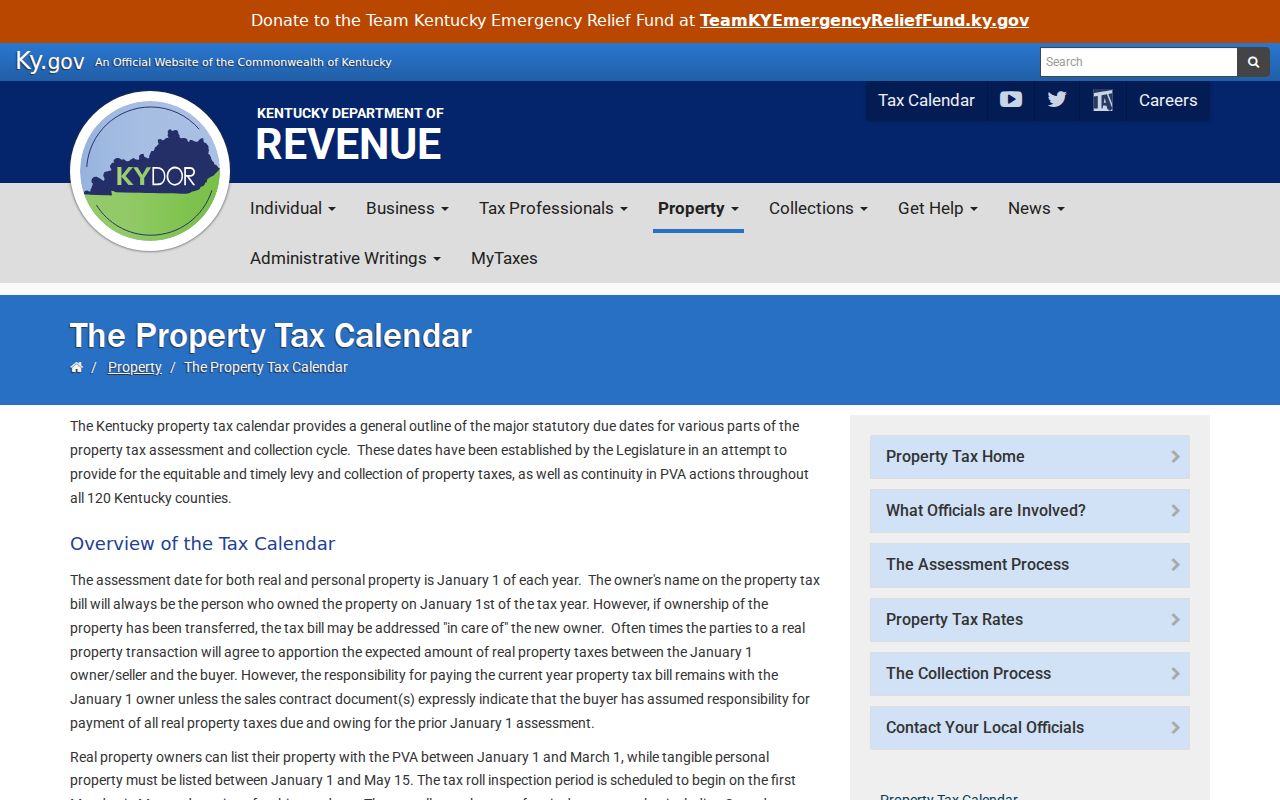
Use the calendar to place an assessment or bill in its correct stage, then confirm the Marion details locally.
Contest a Marion County Assessment in Order
Kentucky's route begins with the annual assessment and a statutory inspection period. An owner first requests a PVA conference, then may move to the local board of assessment appeals and later state review. Follow current DOR calendar dates, never an old deadline.
Appeal window. Request the required PVA conference during the current DOR inspection period before pursuing the local board route.
Useful evidence includes the property card, photos, corrected characteristics, comparable sales, an appraisal, or agricultural-use facts. Kentucky requires a four-year physical inspection cycle, but assessments happen every year.
Request Missing Marion County Tax Records
A portal with no past bill is not proof of no tax. Ask the proper custodian instead. The Sheriff answers collection status. The PVA covers assessment fields. The Clerk holds a transferred certificate or assignment.
A written request through the Kentucky Open Records Act procedure should identify the parcel and tax year. It should also name the record, format, and contact details. The Clerk states a five-business-day response and may require advance fees. That does not make the Clerk custodian of another office's files.
Build a Marion County Tax Evidence Packet
A solid tax record is more than a number copied off a screen. Capture the parcel number and account number. Add the tax year, date checked, every taxing district shown, and the exact status wording. Pair that result with the PVA card for the same parcel and year. The PVA card explains the assessed inputs. The Sheriff result answers the collection question. Keeping those two sources separate prevents a value column from being mistaken for an amount due.
Compare the working and certified assessment columns first. Then check land and improvement values, class, acreage, exemptions, and farm indicators when a figure moves sharply. A shift does not always mean a sale. New construction, a split or combination, reclassification, agricultural treatment, or a changed exemption can explain it. The latest deed can establish whether a transfer occurred. Its consideration, however, should not replace the assessment. Note how the source was obtained. It may have been viewed online, picked up at the counter, received by mail, or supplied through an open-records request. Keep a dated printout or office response. It preserves what was reported and gives the Sheriff or PVA a precise starting point if a correction becomes necessary.
Exemption and agricultural fields deserve the same discipline. An exemption can shrink the taxable base without touching the parcel's fair-cash-value field. Agricultural treatment can separate farm value from other land or improvements. Compare the current and prior year before describing a change. Ask the PVA whether a blank field means zero, not applicable, or simply unavailable data.
The sample report for parcel 064-005 shows structure, not a countywide rule. It displays parcel and account numbers. The full set includes situs, class, district, rate, acreage, ownership and mailing information, valuation columns, exemptions, FCV, and taxes. Never copy that parcel's values into another record. Do not assume every residential or farm card populates identical fields.
Use the Marion County Tax Office Route When the Portal Falls Short
The Marion County Sheriff tax office sits at 223 North Spalding Avenue, Suite 101, Lebanon, Kentucky 40033, and answers at 270-692-3051 during published weekday hours. Online payments are unavailable. The Sheriff directs taxpayers to the office or mail instead. Confirm acceptable payment methods, the payoff amount, and the effective date before sending funds.
The portal's coverage dates, field labels, and bill-history controls are not fully documented. A missing record does not mean nothing is owed. Provide the parcel or account number, owner name, property address, and tax year. Ask whether the bill remains with the Sheriff or has transferred as a certificate of delinquency.
After transfer, the County Clerk becomes the essential record source. Search for the certificate, later assignments, and a release or payment entry. A historical delinquency can stay visible long after its practical significance changes. Identify the latest dated document rather than stopping at the first adverse entry.
Kentucky's delinquency sequence adds useful date checks. DOR describes transfer after the close of business on April 15, notices on May 15 and June 15, and a third-party sale period running from mid-July through late October. It also describes monthly interest and clerk and county-attorney fees. Confirm the current year's procedure before calculating a payoff. A published statewide timeline never replaces the parcel-specific amount supplied by the responsible Marion County office.
An assessment appeal follows a different track from a delinquency. Kentucky's inspection period opens on the first Monday in May and lasts 13 days through the third Monday. A taxpayer may conference with the PVA, then use the local board process in the statutory period. Preserve the notice date, parcel card, photographs, comparable sales, appraisal, repair information, and the exact field challenged.
The appeal can address value, classification, agricultural treatment, exemption handling, or factual characteristics. It cannot decide whether a deed is valid, a mapped boundary is correct, or a lien was released. Direct those issues to recorded documents, a survey, or the courts. If the PVA owner is stale, follow the office's recorded-document or death-certificate correction procedure rather than using the assessment appeal to settle title.
Before closing the file, reconcile every identifier across the PVA, Sheriff, and Clerk sources. A shared street address, former owner, or similar parcel number can lead to the wrong account. Confirm the situs, parcel number, account number, tax district, legal-description shorthand, and relevant tax year together. If one source uses a parent parcel or older name, state that difference and identify the document that bridges it. This final check matters most for divided tracts, estate transfers, and property with separate mailing and situs addresses.