
Compare Marion County Property Value Types
One parcel can carry four different Marion County values. An assessment, a fair-cash field, a net-taxable amount, and recorded consideration all answer different questions about the same parcel. The label and its year belong to the number, and dropping them turns a useful property record into a misleading estimate.
| Value | What It Is | Where |
|---|---|---|
| PVA assessed or FCV field | Mass-appraisal figure under Kentucky's fair-cash-value standard | Marion PVA parcel report |
| Net taxable value | Amount after applicable treatment shown on the assessment | Marion PVA parcel report |
| Recorded consideration | Amount or statement tied to a particular transfer | Recorded deed |
| Independent appraisal | Opinion prepared for a stated date and purpose | Appraiser's report, not the county roll |
The rule is 100 percent fair cash value. Kentucky applies that standard to real property assessment, yet a county mass assessment is never a current purchase offer or a site-specific appraisal of one Marion County parcel.
Keep Four Marion County Value Lines Apart
A good worksheet keeps four Marion County lines apart. Give the PVA assessed or net-taxable value its own row. Give the fair-cash-value field its own row too. The deed's consideration or sale statement gets a row, and the Sheriff's tax balance gets one as well. Add an appraisal only with its date.
This separation catches common errors. A lower taxable amount may reflect an exemption, and consideration can come from an exempt or non-arm's-length deed. A tax balance is a debt status, not land value. Never relabel the largest number as market value when its source uses another term.
Note: Carry the value year beside every figure. Marion County cards can display more than one assessment period.
Read Marion County PVA Value Fields in Context
The county's sample report for parcel 064-005 is instructive. Account and parcel numbers, owner, mailing and situs fields, description, class, tax district, acreage, valuation years, FCV, taxable columns, and taxes all sit on one record. It is a sample, not evidence for another parcel.
Nearby accounts can differ for real reasons. Land, improvements, agricultural acres, exemptions, classification, and tax district explain much of the gap between two Marion County properties. A wrong-looking characteristic deserves a call. Document it, contact the PVA, and never silently alter the source or substitute a nearby parcel.
Look Up a Marion County Property Value
Search starts with a good key. The Marion qPublic search accepts a name, an address, a parcel ID, or an alternate ID, and the parcel number remains the strongest bridge between assessment, map, tax, and deed records.
- Search the address and confirm its situs, parcel ID, and account number.
- Record each value exactly as labeled, along with its assessment year.
- Check acreage, class, land, improvement, farm, and exemption indicators.
- Use the latest recorded deed when a transfer amount or newer ownership event matters.
- Assessed value
- A PVA valuation associated with a stated year and Kentucky's property-tax system.
- Fair cash value
- The Kentucky standard described as the price at a fair voluntary sale.
- Assessment ratio
- A measure comparing assessment to market evidence, used in equalization review.
- Consideration
- The value statement tied to a recorded transfer, subject to deed type and exemptions.
Find Marion County Sale Consideration in the Deed
Consideration is a deed question, not a PVA question. Marion County Clerk deed guidance explains consideration and transfer-tax requirements, correction instruments, quitclaims, leases, and other transfer types. The recorded deed guidance marks where a consideration statement belongs.
A deed amount is historical. Family transfers, gifts, corrective deeds, partial interests, and exempt instruments can make it a poor market comparison. Read the instrument's date, parties, legal description, and deed type before calling the amount a sale price.
How Kentucky Frames Marion County Assessments
Kentucky DOR lays out the statewide frame. It describes sales comparison, cost, and income approaches, plus distinct farm valuation and exemptions. Physical inspection runs on a four-year cycle. Assessment happens every year, and a cycle never proves a particular parcel was inspected in a particular year, as DOR's assessment-process guidance explains.
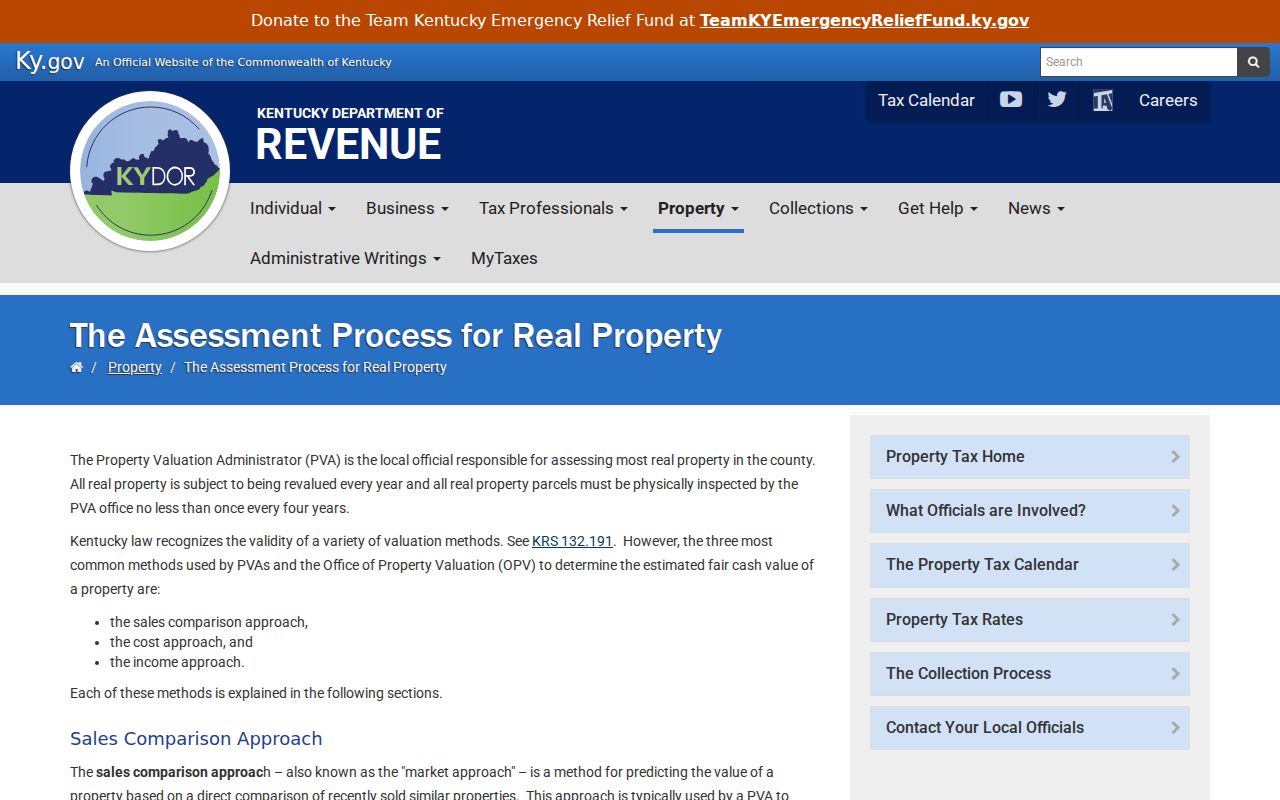
Now apply the framework locally. Read the Marion card's own fields and year, then ask the PVA about any fact that looks stale or wrong.
Why Marion County Assessed Value Changes
Roll values move for many reasons. New construction, updated characteristics, market evidence, classification, agricultural treatment, and exemption status can all change what appears on the Marion County tax roll. A card may be older than the deed. Compare dates before calling a discrepancy an error. Kentucky's 2025 state real-property rate fell from 10.9 to 10.6 cents per $100 while statewide assessments changed. That news sets neither Marion's local rates nor any parcel's value, and it shows why year labels must stay attached.
Limits of a Marion County Property Value
A PVA figure exists for tax administration. It does not establish what a buyer will pay, the cost to rebuild, a lender's collateral conclusion, a legal boundary, or clear title. Recorded consideration is not a present appraisal either.
Value versus price. A Marion County assessed value is not a prediction of sale price and does not replace a current, purpose-specific appraisal.
Tax bills are a different record. For tax-bill status, exemptions, or appeal stages, use the Marion County property tax records guide, since value fields and where they are recorded is where this page stops.
Build a Marion County Property Value Comparison Sheet
Start with the subject parcel itself. Record its exact class, acreage, land value, improvement value, exemption amount, net taxable value, FCV fields, and assessment year. Pick comparisons that share real characteristics. A farm parcel, a commercial plant, a vacant lot, and an improved residence can share the same road while demanding different analysis.
Preserve each comparison's parcel ID and date viewed. Check the deed before trusting consideration. Gifts, family transfers, corrective deeds, partial interests, and exempt instruments may carry amounts that never describe open-market value. Keep the PVA figure, deed consideration, independent appraisal, and Sheriff balance in separate columns.
The PVA sales list can help in a conference. Evidence should address the parcel's condition and characteristics on the relevant date. Photographs, repair records, an appraisal, and well-matched sales beat a general claim about nearby prices. Facts persuade. A documented difference earns review where a complaint about the neighborhood does not.
Time a Marion County Property Value Review Correctly
Kentucky opens its inspection period on the first Monday in May. It runs 13 days, ending on the third Monday. A taxpayer can conference with the PVA during that window. The formal appeal sequence then starts one workday later. Check with DOR and the local office for current-year dates.
A value review can address several things. It covers valuation, classification, an omitted exemption, agricultural treatment, or a wrong parcel characteristic. It cannot settle deed validity, a boundary dispute, or a lien. Those belong with the County Clerk, a surveyor, or the court record.
The PVA inspects parcels physically on at least a four-year cycle. New construction gets added annually. Still, that schedule does not prove your parcel was visited this year. Ask what evidence supported the current entry. Pinpoint any incorrect field exactly. Ownership is sometimes wrong. The PVA FAQ points to a recorded document or a death certificate. That is the correction route.
The statewide ratio study uses a 90-to-110 range. That is an assessment-performance measure, not a formula for adjusting one Marion County property's value. An individual appeal still needs parcel-specific evidence, the correct stage, and a clearly identified field.
Recent rate news deserves careful labels too. DOR reported a 2025 state real-property rate of 10.6 cents per $100. That was down from 10.9 cents in 2024. County, school, and district rates stay separate. A rate change alone says nothing about whether a parcel gained or lost value. Keep rate, assessment, and bill conclusions in separate worksheet sections.
End each review with a dated source line for every number. Note whether it came from a working or certified PVA year, a recorded deed, a Sheriff result, or an independent appraisal. Note whether the source is official. That line preserves the comparison if a portal changes later. It also keeps an old assessment, nominal deed consideration, or historical tax amount from masquerading as a current Marion County property value. Evidence sometimes conflicts. Report the conflict. Ask the responsible office about the field rather than averaging unlike figures.