
How to Find Who Owns a Marion County Property
Work from the land first, not from a hunch about a person. A Marion address identifies a qPublic parcel. The parcel card then supplies the assessed owner label. It also gives stable identifiers. Finally, the newest matching deed confirms who received the recorded interest. That order keeps an owner, a mailing recipient, and an occupant clearly apart.
- Search the address. Select the qPublic result whose situs and map location match.
- Capture the parcel. Save the owner label, parcel ID, account number, acreage, and tax district.
- Search the owner name. Use exact variants in the clerk index, in both grantee and grantor directions.
- Read the deed. Match its legal description and source-of-title reference to the parcel.
Two independent county sources answer the practical "who owns" question better than a single database label ever could.
Read Marion's Owner Label
The Marion PVA search takes a name, address, parcel ID, or alternate ID. A parcel card may list the primary owner, mailing and location addresses, parcel and account numbers, class, district, acreage, values, exemptions, and map route. Treat the card as your coordinate system for the property search. Copy its terms exactly. When the owner line shows a trust, estate, LLC, corporation, or partial interest, keep every word intact before you search the recorded instruments.
Where Marion County Property Ownership Is Recorded
Marion County splits ownership evidence by function. The PVA roll serves as the fastest present-day index. The County Clerk's deed provides the recorded proof of transfer. The parcel map keeps your property search anchored to the right tract. The sheriff's tax record can cross-check an account and year. It cannot establish title on its own.
| Source | Ownership clue | Limit |
|---|---|---|
| PVA parcel card | Primary owner label and mailing record | May lag a recent deed |
| Recorded deed | Named grantee and conveyed interest | Must read the instrument, not only its index row |
| qPublic map | Parcel location and nearby tax outlines | Not a survey or title document |
Confirm the Marion Deed
Open the Marion recorded-document index and search the PVA owner as grantee, then as grantor. Then compare the newest candidate against the parcel card. Check the recording date next. Match the legal description, book and page, and source deed as well. A name that matches while the land does not is weak evidence. The index covers documents through May 17, 2026. It cautions that indexing may lag behind that date. It publishes no earliest online year. Ask the clerk about a very recent instrument or an older book. The official index page displays the route this confirmation follows.
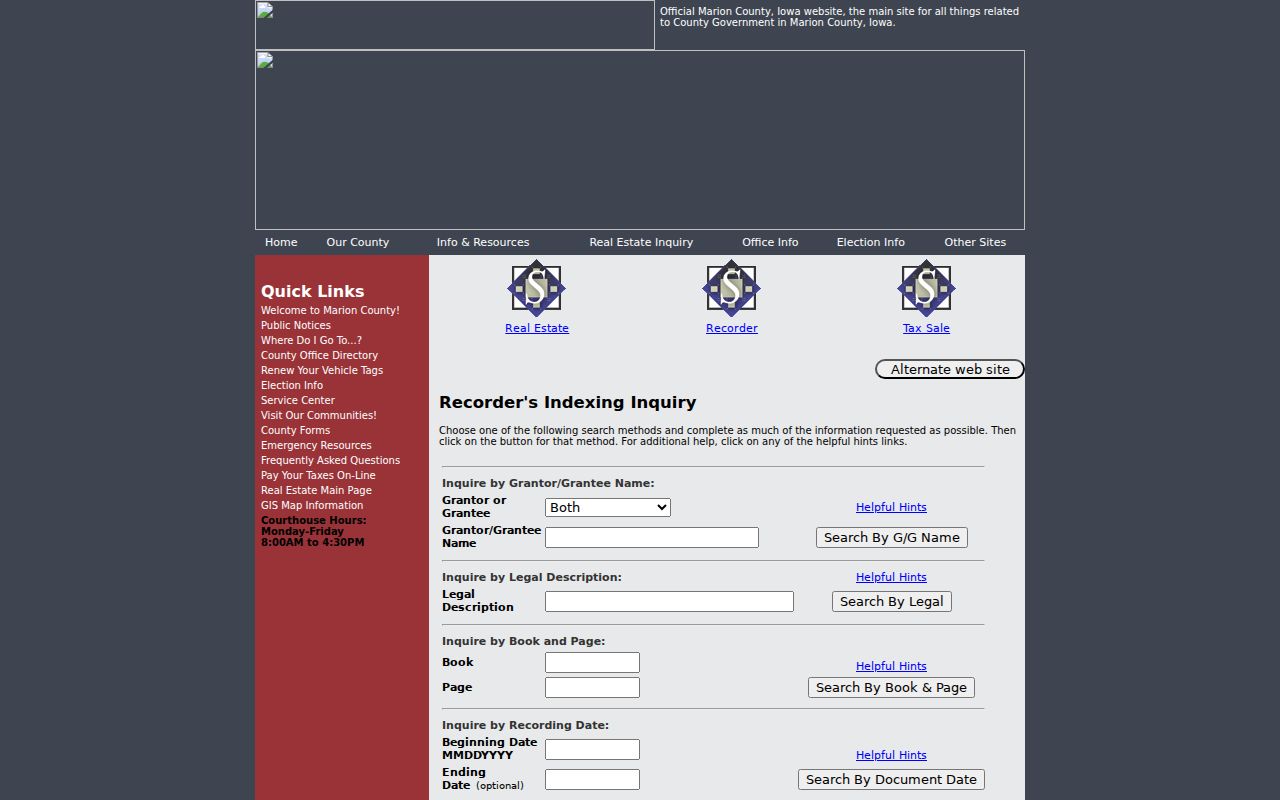
Rely on the deed image, not the index row alone, for the legal description and the conveyed interest.
New Deed, Older Roll
The PVA FAQ requires an official recorded document to add, change, or remove a name on the property record or tax bill. That document can be a deed or will. A death certificate also works. The office publishes no set refresh interval. So a new deed can settle who owns the land. The displayed tax roll may catch up later. Date-stamp both checks. Note when the deed was filed and when you viewed the PVA card. If the property records disagree, ask the PVA about refresh timing. Do not just pick the more convenient name.
Trust and Estate Owners
A grantee may be a trust, an estate, a corporation, an LLC, or several parties holding stated interests. Keep the punctuation, suffixes, trustee capacity, and percentages exactly as written. The Kentucky business entity search can clarify a company's exact name or status, though it proves nothing about land title. Estate ownership may point to a will, a probate-related file, the death certificate route, or a later deed. Kentucky death records stay confidential for fifty years under KRS 213.131, with access tied to authorization. Use only the personal information the parcel question truly requires.
Marion Owner Search Fallbacks
The Marion County PVA handles parcel identity and owner-roll questions. You will find it in Suite 202 at 223 North Spalding Avenue in Lebanon. The County Clerk sits in Suite 102 at the same address. That office handles deeds plus written record requests. Its open-records route accepts hand delivery, email, mail, and fax, requires advance fees, and states a five-business-day response. A chain of title sometimes reaches past online deed records. KDLA lists Marion deed film from 1863 through 2010 and plats from 1877. The local library's Genealogy Room adds microfilm, newspapers, obituaries, and family files. For older tracts, try a creek, church, railroad, road, or neighboring owner's name. It often works better than a modern address.
Protected Marion Addresses
Kentucky's Safe at Home program can mask an eligible participant's address in public records. A missing or protected address never justifies hunting down a substitute source and republishing it. The official state notice explains the protection.

Stop your ownership research at the facts the land question needs, and respect any protected address.
Follow Partial Interests in Marion Deeds
A deed rarely tells the whole story at a glance. Marion deeds can name several grantees. They can state percentages, reserve an interest, or convey a single tract from a larger account. The newest index surname may not answer who owns the entire parcel. So the full ownership picture takes more reading. Read the vesting language closely. Then check the legal description, exceptions, reservations, and source-of-title statement. Compare each named interest against the PVA parcel. Also check it against any later deed, release, or court order.
Signers matter too. A spouse, trustee, personal representative, or entity may sign in a stated capacity. Copy that capacity exactly. That wording can explain why the signer differs from the assessed owner label. It does not prove the signer personally owns the land. A focused Marion owner inquiry follows the interest described in the instrument. It stops short of guessing about beneficial interests the public record does not establish.
Use the Marion Parcel as the Control
Common surnames return several Marion County hits. The parcel number keeps a search honest. Situs, acreage, tax district, and legal-description terms do the same. Run each candidate name in both grantor and grantee directions. Reject any result whose tract or source deed does not match. A name match is a lead, not a complete ownership finding.
Splits and combinations add another layer. Ask the PVA for that history, then trace the parent tract through the deed chain. Old rural descriptions reward creativity. Use roads, creeks, churches, rail references, and adjoining owners as extra search terms. Those clues can bridge a modern parcel card to a recorded book and page. They also keep the conclusion centered on land rather than on a person.
What a Marion Ownership Lookup Cannot Tell You
A public owner name has limits. It cannot tell you who occupies a house, who benefits from a trust, whether every interest is recorded, or whether title is marketable. Entity records have limits too. An LLC profile clarifies a name but not land ownership, and a map outline identifies a tax parcel but not a boundary. Read before you conclude. Vesting language, exceptions, reservations, legal descriptions, and later instruments all shape the answer.
Conflicting evidence deserves respect. Preserve both dates and contact the custodian, because a newly recorded deed and an older assessment roll can both be authentic records from different stages of an update.
Access Marion Owner Records Offline
Some questions still work best in person. The PVA takes parcel and assessment questions at 223 North Spalding Avenue, Suite 202, in Lebanon. It also answers by phone at 270-692-3401. The County Clerk sits in Suite 102. That office handles deed images, plats, liens, releases, and record-copy requests at 270-692-2651. A precise open-records request can go by hand, email, mail, or fax. The clerk's published process calls for fees in advance. It allows five business days for a response.
Older chains need other channels. When an ownership chain outgrows the online index, KDLA lists Marion deed microfilm from 1863 through 2010. It also lists plats from 1877. The county library holds newspapers and microfilm. Send party names, approximate dates, record type, and any known book/page or legal-description terms. These channels matter. The live recorder notice warns that indexing may lag its displayed through-date.
Resolve a Marion Owner-Name Mismatch
A mismatch is not always an error. When the deed and assessment card name different owners, compare dates before assuming either source is wrong. Note the deed's execution and recording dates. Note the assessment year too. Confirm that the legal description, parcel location, acreage, and source deed all point to the same land. A recent grantee can appear in the recorder before the assessment roll updates.
Capacity can also explain the gap. A trustee, personal representative, surviving party, corporation, LLC, or person holding only a stated percentage may be named differently across records. Preserve titles, suffixes, punctuation, vesting language, exceptions, and reservations exactly. If the parcel was divided, follow the parent tract and each child description. Ask the PVA about its owner-update route. But describe the interest conveyed by the recorded instrument rather than a shortened index label.