
What Marion County Deed Records Convey
Read Marion County deed records by instrument type. One deed is not proof of everything. The clerk's deed guidance covers conveyances, easements, corrections, quitclaims, deeds of trust, leases, manufactured-home filings, and transfer-tax requirements. Each type touches the land differently. A single deed may convey only part of a tract, or a limited interest rather than the whole fee.
| Deed form | Recorded effect | Typical research use |
|---|---|---|
| General or special warranty deed | Conveys the interest described with stated warranties | Identify a purchase transfer and its source deed |
| Quitclaim deed | Conveys whatever interest the grantor held, without added warranty | Resolve family, marital, or corrective interests |
| Correction deed | Corrects a stated problem in an earlier instrument | Reconcile a name, description, or prior reference |
| Gift or estate-related deed | Transfers an interest outside an ordinary sale | Follow an inheritance, trust, or family transfer |
| Deed with easement or reservation | Transfers land while creating or retaining a stated right | Track access, utilities, or reserved interests |
Mortgages, liens, releases, restrictions, plats, and condominium instruments sit near deeds in the index. They do different work. Read each document's label and legal description before assigning it a place in the title chain.
Search Fields in the Marion County Deed Index
Several routes open through the Marion County recorded-document index. Party-name search fits a known owner. It needs exact spelling. Legal-description terms reach rural or historic tracts that never carried a modern street address, and book and page serves best when another instrument already supplies the citation.
| Index field | Input | How to use it |
|---|---|---|
| Party direction | Grantor or grantee | Search both roles to see incoming and outgoing transfers |
| First and last name | Text | Try exact names, variants, trusts, estates, and entity suffixes |
| Legal description | Text | Use tract, lot, subdivision, creek, road, or neighboring-owner terms |
| Book and page | Reference pair | Open a citation copied from a deed, mortgage, plat, or release |
| Recording dates | Beginning and optional end date | Enter dates in MMDDYYYY format and widen the range as needed |
The index page requires JavaScript. No pagination, images, or export appear. Earliest coverage goes unstated, so the courthouse remains the fallback when a result will not open, and the official index for Marion County deed records is still the county's designated route.
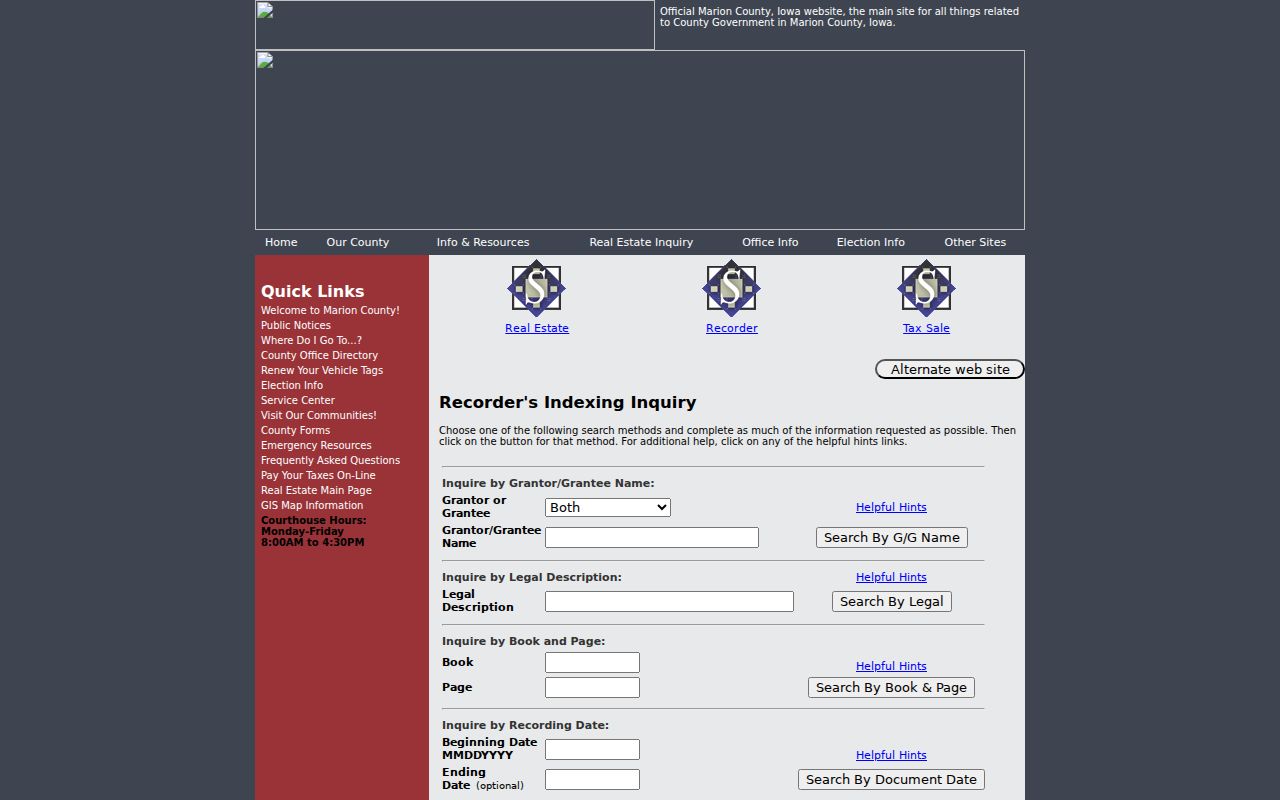
The screen confirms nothing by itself. Read and cite the clerk's recorded deed, not the page image.
Follow Marion County Deeds Through Both Party Roles
Every chain starts with one known deed. The grantee received the stated interest. The grantor conveyed it. Moving backward means finding the grantor's own earlier acquisition and repeating the process, with every step tied to the same land through its description, acreage, lot, tract, or cited source deed.
- Use the PVA parcel card to copy the current name, parcel number, situs, and any deed reference.
- Search that name as grantee and inspect the newest candidate transfer.
- Read its grantor, legal description, and source-of-title clause, then search that grantor as an earlier grantee.
- Record execution and recording dates, deed type, book/page or instrument number, and any excluded tract.
- Repeat until the online index stops, then carry the last reliable locator to the clerk or KDLA.
- Grantor
- The party conveying the stated interest.
- Grantee
- The party receiving the stated interest.
- Chain of title
- The linked series of conveyances affecting the same land.
- Book/page or instrument number
- The clerk's locator for a recorded filing.
Marion County Source Deeds, Exceptions, and Parent Tracts
The source-of-title clause often does more work than an address search. The words "being the same property conveyed by" are a pointer. They lead straight to an earlier deed. A "less and except" clause removes land from a bigger tract. Cited surveys, subdivision plats, cabinets, and slides matter too. Together they explain why a modern parcel number covers only part of an older deed.
Rural Marion County deed records reward patience. Older papers lean on acreage, road and stream calls, neighboring owners, churches, schools, and tract names rather than street addresses. Those phrases may be the only stable search keys. One instrument can hold several tracts, so separate each one and match it to its present PVA parcel in your notes. Tax units change over time. A unit may have grown from a split or combination, so a mismatch alone does not make the old deed wrong.
Note: A legal-description match outweighs a shared surname or street address when deciding whether a deed belongs to the parcel.
A complete review preserves the preparation statement, return-mail address, tax-bill address, notarization, recording stamp, and any attached exhibit. Consideration statements vary. They may be ordinary, nominal, or exempt. Read none of these patterns in isolation. Exempt does not mean invalid. An exempt or nominal statement can accompany a valid family, estate, trust, or corrective transfer, and it never erases the need to match the land.
Easements deserve their own check when a deed names a shared drive, utility line, road, or reserved access. Search both parties, the parent tract, nearby owners, and any cited plat. A driveway visible on the PVA map proves nothing. The legal right comes from the recorded easement. Amendments and releases finish the story.
Why the Marion County Index Date Needs a Clerk Check
The online recorder index ran documents through the close of business on May 17, 2026. A warning noted indexing might lag behind that date. That notice matters most after a recent closing. A missing online result cannot prove that no deed was recorded. No official earliest year of online coverage is published. Search narrow date windows around a known transfer. Then widen the dates and try both party roles. If the newest instrument still does not appear, call the Marion County Clerk at 270-692-2651 or visit the records counter. The office sits at 223 North Spalding Avenue, Suite 102, Lebanon. Published weekday hours are 8:20 a.m. to 4:20 p.m., and the Saturday notation appears inconsistent, so confirm weekend hours with the office.
Recorded is not a title opinion. The index locates filed instruments, but unrecorded claims, description errors, and unresolved interests may still require professional title work.
Older Marion County Deed Records Cross an 1863 Break Point
The Kentucky Department for Libraries and Archives land inventory covers Marion deed microfilm from 1863 through 2010. It also lists plats on microfiche starting in 1877. That starting year matters. Marion County split from Washington County in 1834. KDLA flags a courthouse disaster in 1863. The inventory does not name every lost or reconstructed volume. So not every earlier deed vanished. Claiming a total wipeout would misstate the record.
A chain may hit that 1863 break. Write down the exact missing book, date, party, and tract. Ask the clerk what survives. Compare KDLA film. Then check tax books, wills, Washington County records, and state land sources for the earlier period. Historic plats and tax assessment books can still supply names and geography. They support the search without replacing the conveyance itself.
Note: KDLA's film dates describe archive holdings. They are not a promise that every Marion County deed image is searchable online.
Estate and Trust Names in Marion County Deeds
Deed chains often break at estate and trust transfers. Property can also pass through a joint interest or a court-authorized sale. Copy the party's name exactly as indexed, including executor, trustee, estate, or percentage-interest wording. Then read the deed and any will, affidavit, probate order, or prior conveyance it cites. Kentucky vital records can help confirm identity or authority. Their confidentiality and eligibility rules still apply.
The Marion County Clerk keeps wills and other local records. Older will film may sit with KDLA. The Marion County Public Library genealogy room adds newspapers, family files, obituaries, and microfilm. Those sources can link a name to a tract. Still, the recorded instrument remains the key evidence of which land interest changed.
Businesses show up as grantees too. Kentucky's Secretary of State entity search can verify the filed company name. It can also separate lookalike firms. It cannot prove the entity still owns the parcel. Nor can it identify every person with an economic interest. Preserve the deed's exact grantee wording first. Then use the entity profile only to clarify the party. The party searched in Marion County deed records benefits from that precision.
Request a Marion County Deed by Its Locator
A good index hit is only the start. Write down the exact party names, document type, recording date, book and page or instrument number, and legal-description terms. Those details unlock the instrument, whether you pull it online, at the counter, by phone, or through a written request. The published fee page is dated 2020. It warns that schedules may vary, so confirm the present charge instead of trusting an old figure.
Ordinary access can still fail. The Marion County Clerk open-records route accepts a precise request. It explains advance fees and a five-business-day response statement under the Kentucky Open Records Act. A strong request names the record, date range, parties, book and page, preferred delivery form, and contact details. The library, historical society, and KDLA suit older material. None replaces a certified clerk copy.
The clerk's deed guidance helps a reader recognize the fields a recorded transfer requires. The deed itself supplies the parcel-specific facts.
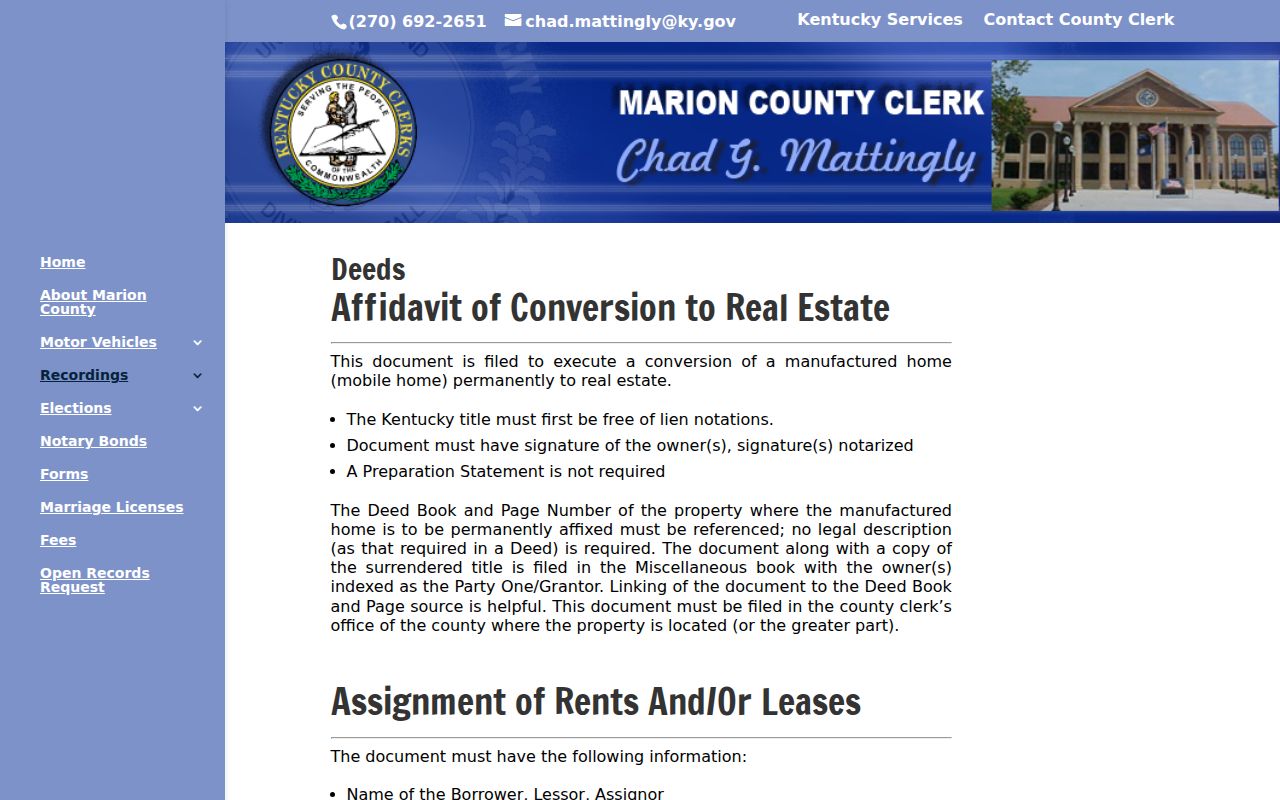
The guidance breaks down a deed's anatomy. The deed itself supplies the parcel-specific facts a Marion County property search turns on.